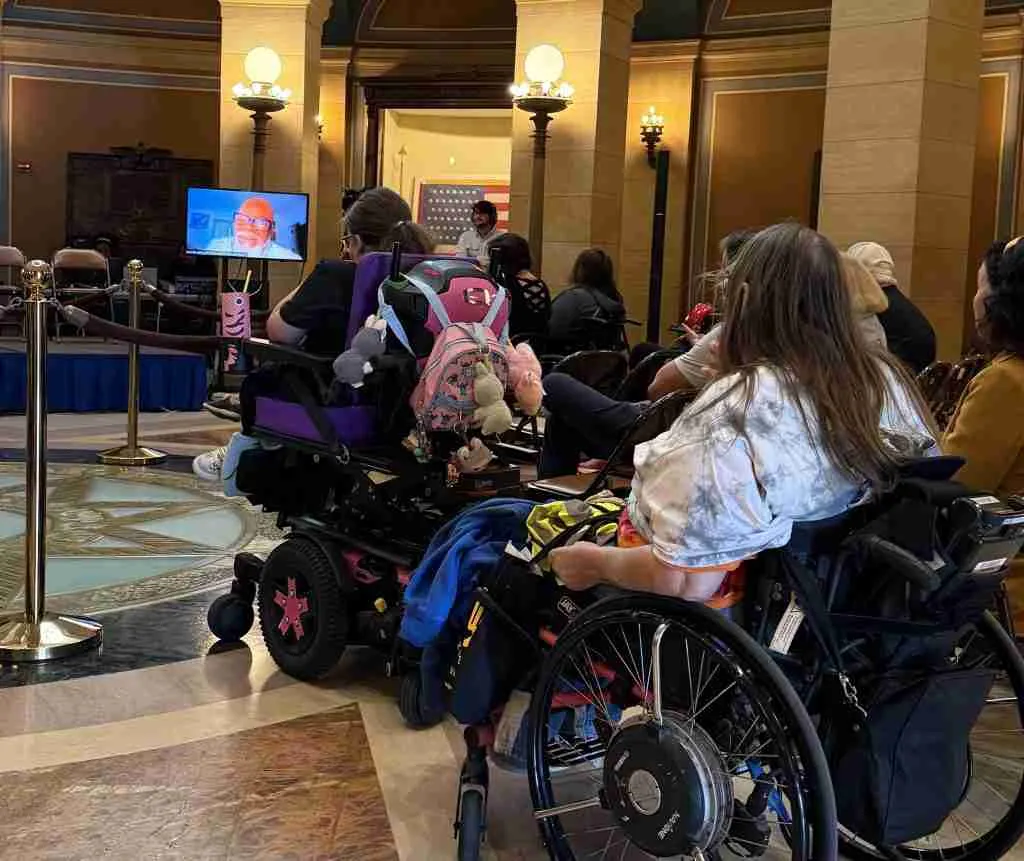
On September 17, advocates and community members gathered with state officials at the Minnesota State Capitol for Constitution and Citizenship Day, an event hosted by the Metropolitan Center for Independent Living (MCIL). The event celebrated and highlighted efforts to make sure every Minnesota citizen with a disability has the right to fully and independently vote.
The event kicked off with the reading of an official state proclamation designating Constitution Week. The proclamation emphasized that accessible, fair, and secure elections are vital to preserving a government that truly belongs to all citizens.

Remembering that “we the people” includes everyone
Theo Braddy, executive director of the National Council on Independent Living (NCIL), delivered the keynote address via video. He incurred a cervical spinal cord injury when he was 15 years old and has spent his life advocating for disability rights. Throughout his advocacy, he learned that independent living and democratic participation are inseparable. “Independent does not mean doing everything by yourself,” Braddy said. “Independent means having control over decisions that affect your life… and that is citizenship”.
Braddy said that civil rights victories like Section 504 of the Rehabilitation Act and the Americans with Disabilities Act (ADA) were won little by little through tireless grassroots organizing. He also warned that rights can just as easily be taken away little by little if communities fail to stay engaged and vote.
Guardianship and voting rights in Minnesota
Professor Lisa Schultz from the University of St. Thomas School of Law explained how voting rules work in Minnesota. While the U.S. Constitution provides broad civil rights protections, each state controls most of its own election rules. Historically, many states passed laws that blocked people with intellectual, developmental, or psychiatric disabilities from voting. Some states still have outdated words in their laws that make voting harder. Minnesota offers strong protections to keep voting accessible.
Dan Stewart, ADA advocacy response director at MCIL, led a panel where legal experts explained these rights. Chad Wilson, an attorney with the Minnesota Disability Law Center, shared a clear reminder: “Voting is a right, not a privilege. It is your right”. Wilson also cleared up a common myth about legal guardianship. Many people believe that having a guardian automatically means you cannot vote, but that is not true in Minnesota. Adults with guardians keep their full right to vote unless a judge specifically signs an order taking that right away.
“In Minnesota, if you are under a guardianship, you still have the right to vote unless that guardianship order specifically states that the court has taken away your right to vote. No one can tell you that you can’t vote, and no one can tell you how to vote,” Wilson said.
Accessible technology protects privacy at the polls
Casting a private and independent ballot is a protected civil right. In Minnesota polling places, voters have access to certified assistive ballot-marking devices, including Omni Ballot, ImageCast Evolution, Verity TouchWriter, and AutoMark. These machines do not store or count votes; instead, they help voters mark official paper ballots accurately and privately.
Key accessibility features include:
- Audio assistance that reads ballots aloud through headphones, paired with tactile braille keypads.
- Screen privacy options that black out the display completely so no one nearby can see selections.
- Error warnings that alert voters if they accidentally vote for too many candidates in a race, preventing disqualified ballots.
Christopher, a blind voter, praised these tools during an MDLC community briefing, “For the last few election cycles, I have actually been using them…because I’m totally blind, it makes my voting privacy so much easier because I can just go up there to the polling place and…they’ll get me set up on the ballot marking device and then I use the headphones and the actual keypad…and I’ve had no issues with it at all.”
Multiple ways to cast your ballot across Minnesota
Minnesota offers several flexible pathways for casting a ballot: • Accessible absentee voting: Voters with print disabilities—including blindness or physical conditions making pen and paper difficult—can request an electronic ballot from their county election office. Voters complete the ballot privately on a computer using screen readers, print it out, and return it by mail.
- Mail-in voting: Open to all registered voters without an excuse, though ballots must arrive by Election Day to be counted.
- Curbside voting: Available for voters facing mobility barriers entering a polling place. A bipartisan team of two election judges brings ballots and materials directly to the voter’s car.
- In-person assistance: Voters may bring a trusted family member or friend into the booth, or request help from two election judges from different political parties. Melanie Hazelip from the Secretary of State’s office highlighted that Minnesota ranks first on the MIT Election Performance Index, pointing to public accuracy tests as proof of the state’s transparent and secure process.
Planning ahead and getting support
Gene Martinez, coordinator for REV UP MN (Register, Educate, Vote, Use your Power) and legislative advocacy coordinator at The Arc Minnesota, emphasized that voting directly shapes funding for healthcare, accessible housing, and transit. Through nonpartisan voter education forums and candidate engagement, REV UP MN works statewide to boost turnout and ensure candidates address disability priorities.
Advocates urge voters to verify their registration, view sample ballots at mnvotes.gov, and plan ahead. If you encounter any barriers or have questions regarding accommodations, contact the Minnesota Disability Law Center at 612-334-5970 (toll-free at 1-800-292-4150) or visit mylegalaid.org. When people with disabilities vote, they ensure that “we the people” truly includes all people.