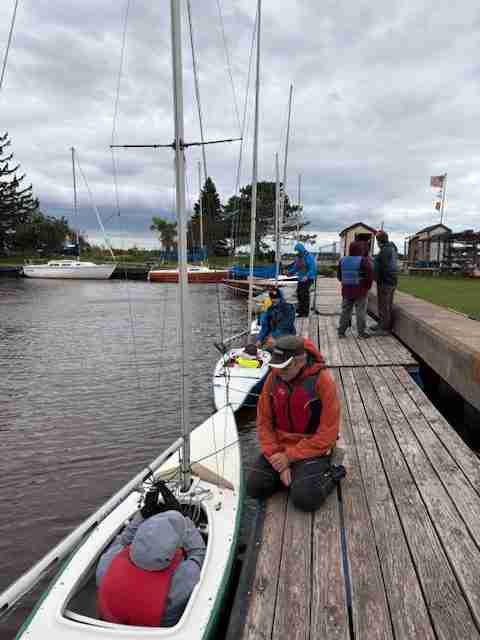
For individuals who are blind or visually impaired, the simple act of navigating daily life can come with numerous hurdles. Driving a car, for example, isn’t an option. But out on the open water, where the wind guides the way and the boat becomes an extension of the senses, a deep sense of freedom awaits. Thanks to the efforts of Katie Boyd and the newly established sailing programs in Minnesota, the blind and visually impaired community is mastering the water like never before.

From Boston to the land of 10,000 lakes

When Katie Boyd, who is legally blind and has Retinitis Pigmentosa (RP), moved from Boston to Minnesota in 2023, she brought a profound passion with her. Having discovered a love for sailing on the East Coast over a decade ago, she found the ocean to be her “happy place”—a space where she felt completely free.
Upon arriving in Minnesota, however, she quickly realized that the local sailing scene didn’t have an established program for blind sailors. Unwilling to leave her passion behind, she reached out to Matt at Wayzata Sailing and Ted at the Minneapolis Sailing Center. Both organizations enthusiastically jumped on board, and Twin Cities Blind Sailing (TCBS) was born. Today, under the broader umbrella of the US Blind Sailing Association, the program is transforming the landscape of accessible recreation in the state.
How do you sail without sight?
To the uninitiated, sailing blind might sound impossible. But as Boyd explains, sailing relies heavily on the other senses. You don’t need perfect vision to feel the direction of the wind on your face or sense the subtle shift in the boat’s momentum. Sailors listen to the water, the rustling of the sails, and even the surrounding land traffic to orient themselves.
By combining heightened sensory awareness with specialized tools like tactile maps, blind sailors can expertly trim sails, steer the tiller, and navigate across the lake.

A program for every sailor
Twin Cities Blind Sailing, partnered with the US Blind Sailing Association, has rapidly expanded to offer a variety of programs tailored to different interests and skill levels:
- The Cruising Group (Minneapolis Sailing Center): Hosted at Lake Bde Maka Ska, this program is all about learning at your own pace. It is a low-stress environment where visually impaired sailors learn how to rig the boat, understand its mechanics, and take it out on the water to simply enjoy the ride.
- The Racing Group (Wayzata Sailing): For those seeking a competitive edge, the racing group at Lake Minnetonka teaches sailors the adrenaline-pumping intricacies of competitive sailing. TCBS is even in the process of planning a racing clinic featuring Betsy Alison from US Sailing to introduce fleet and match racing.
- Solo Sailing (Lake Harriet Yacht Club): Driven by Boyd’s desire to give blind sailors the exact same opportunities as sighted individuals, the solo sailing program offers the ultimate independence. A visually impaired sailor captains their boat entirely on their own, accompanied only by a sighted guide trailing closely in a chase boat. Lake Harriet is also equipped with adaptive hoists to make the program accessible for sailors in wheelchairs.
- Youth Camps: In 2024, TCBS made history by hosting the world’s first-ever week-long youth camp dedicated strictly to blind sailors, establishing a pipeline of confidence and skill for the next generation.
Expanding north and looking ahead
The momentum isn’t stopping in the Twin Cities. The program is actively expanding to northern Minnesota with the launch of Duluth Blind Sailing, which kicks off a new cruising program on Lake Superior starting in mid-June with dedicated, trained sighted guides.
Looking to the future, Boyd envisions taking the team further than ever before. Plans are in the works for larger keelboats, week-long navigation courses, and even an expedition to the US Virgin Islands.
The core mission of the US Blind Sailing Association—and its growing Minnesota chapters—is simple: empower the blind and visually impaired to experience the joy of sailing while building independence, confidence, and community engagement. Whether it’s casually cruising across Bde Maka Ska or solo-captaining a vessel on Lake Harriet, blind sailing is proving that the inability to see doesn’t mean an inability to steer the ship.
To learn more, register for the 2026 season, or volunteer as a sighted guide, visit Twin Cities Blind Sailing and the US Blind Sailing Association.