For many, opening a textbook, taking notes, and asking questions are part of everyday classroom life. Those everyday tasks can be complicated for students with disabilities, but assistive technology is making learning more accessible.
“It’s really hard for schools to stay up to date with things, and I think in general, schools are doing a really good job, but there’s always going to be gaps just because technology changes so quickly,” Paul Sanft, director of the PACER Simon Technology Center, said.
Assistive technology includes devices, software, and other tools that help people communicate, read, write, hear, see, and move so they can participate more independently in the classroom.
“We have technology in all those different areas that help people in different ways,” Jamis Wehrenberg, the assistive technology professional with the Minnesota STAR program, said.
Sometimes the technology can be as simple as ear protectors or an alternative way to open a locker.
“Assistive technology can be as small as a pencil grip. Right? So I think sometimes people hear that term and they think it has to be a massive piece of machinery, and that’s just not true,” Jamie O’Conner, the assistant executive director at Family Voices of Minnesota, said.

Assistive technology can help people with tasks like reading and writing.
Some of these devices can be simple; others can be expensive. The Minnesota STAR Program wants to make sure that, before you invest, the device works for you.
“A young man came in who had had a stroke at a very early age and was looking for ways to communicate. His biggest thing was just, as a young kid, being able to read texts from friends. That was just a huge struggle for him. I showed him some simple, built-in accessibility features in his iPhone. He could type out a text and have it spoken to him to make sure that it’s correct before he sent it. That simple little thing just changed his whole life,” Wehrenberg said.
How assistive technology can help students
The technology being used in schools helps open doors for students with disabilities, allowing them to get on an even playing field with their peers.
“What could be frustrating to them in the past could now be doable in the present, and they have a lot of encouragement to be able to push through and finish school and learn more,” Wehrenberg said.
Much of the focus is on helping kids take notes, communicate, and be more independent in the classroom, but there’s one major part of school that families and teachers often overlook.

Finding new ways to play video games can help children feel empowered.
School can be a stressful place for some students, and that anxiety can affect their ability to learn and enjoy school. Assistive technology can also help students manage stress and anxiety through tools designed to keep students calm.
“Families and school teams really can expand their thinking about what assistive technology can provide to the student. It’s not all about reading and writing or using a calculator, for example.Those are important, but if kids are stressed out at school, having calming music on their iPad or comfort-type devices or fidgets,” O’Conner said.
When it comes to finding the right technology, it’s important that the student has a say in the process, something as simple as the color of a device can make a difference.
“We want that student involved. We want them involved in the decision-making. We don’t want guardians or teachers making that decision for them. So if they’re involved in the process, they’re more likely to adopt that technology versus abandon it,” Wehrenberg said.
Where you can find resources for the school year
As your child returns to the classroom, you have many options to try, learn, and get support from organizations around Minnesota.
“Coming up in September, we’re doing a three-part series on general technology to help with reading, then another one to help with writing, and then another one specifically for math. And that’s for all ages. So we’ll demonstrate different technologies that are specific to that and also talk about how people can learn more info,” Sanft said.

Children have fun exploring new educational technologies.
One place you can get information is the PACER Center’s new AI assistant, PACER PAL, which is available 24/7.
“It will direct them to the resources at our Simon Technology Center. The tool is able to give generalized examples of different types of assistive technology that may be useful,” Gretchen Godfrey, associate director at the PACER Center, said.
Once you figure out technology that might be useful, you can test it through the Simon Technology Center’s lending library.
“We have an assistive technology lending library that’s free to anyone in Minnesota, where people can check out and borrow technology to try it out in their home or work or school to see if it is something that would solve their needs,” Sanft said.
Family Voices of Minnesota can also connect you with other families and school professionals to learn more about the technologies helping families like yours.
And if you feel your child’s Individualized Education Program (IEP) isn’t being followed, Family Voices of Minnesota can help connect you with organizations that can provide support.
“We can really help them with skills that would enhance their collaboration with school professionals. We can give them input on the process for disagreeing with the school and connect them with other organizations that can help with that process,” O’Conner said.
The future of assistive technology in school
As technology improves and everything becomes more digital, some schools may have safety concerns.
“You have to protect other students. So, those are some of the biggest barriers that I see in adopting technology because it doesn’t meet a secure environment,” Wehrenberg said.
Wehrenberg sees wearable technology as the future of assistive technology. The main purpose is to blend in rather than stand out, helping the student not only in the classroom but also socially.
“They’re coming out with rings that you can wear that help people do things, whether it’s turn on a light or record notes. … It looks like a regular piece of accessory on your body, doesn’t stand out. So I think you’ll see a lot more technology that’s wearable,” Wehrenberg said.
The main goal of all the new technologies is to make sure kids with disabilities get the same chance to learn, socialize, and develop as kids without a disability.
“Trying to figure out what needs to be in place for our kiddos to be out in the community, including school, as much as possible is really important to their development and their lifetime safety,” O’Conner said.

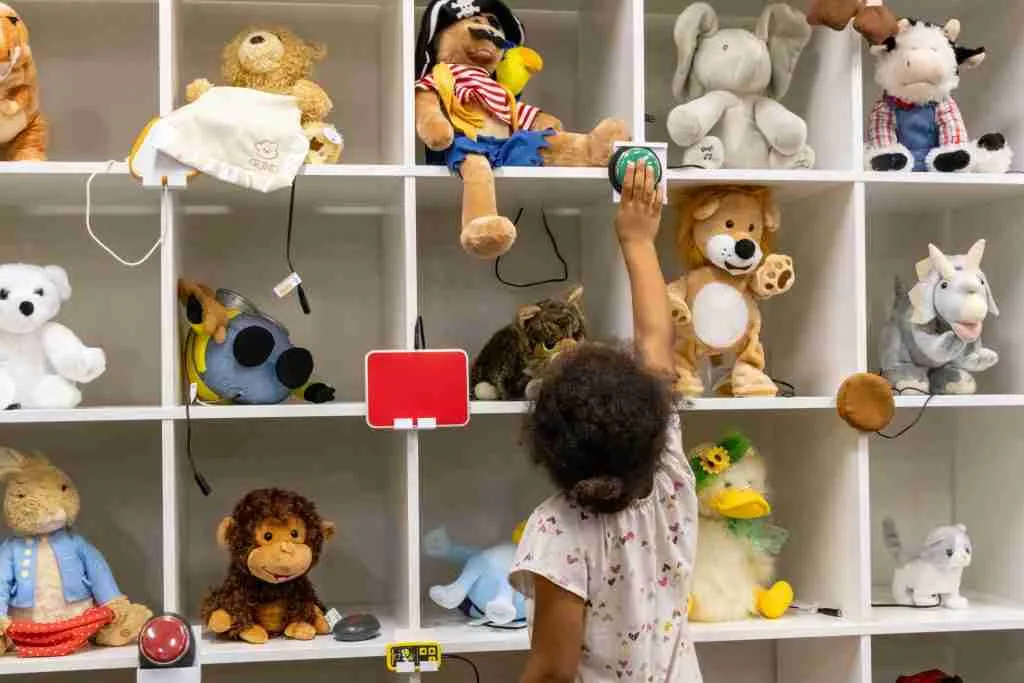
Child uses assistive technology to interact with a room filled with toys and stuffed animals.